Ridge Vent vs Box Vent: Which Roof Ventilation System Works Best in Edmonton’s Climate?
April 17, 2026
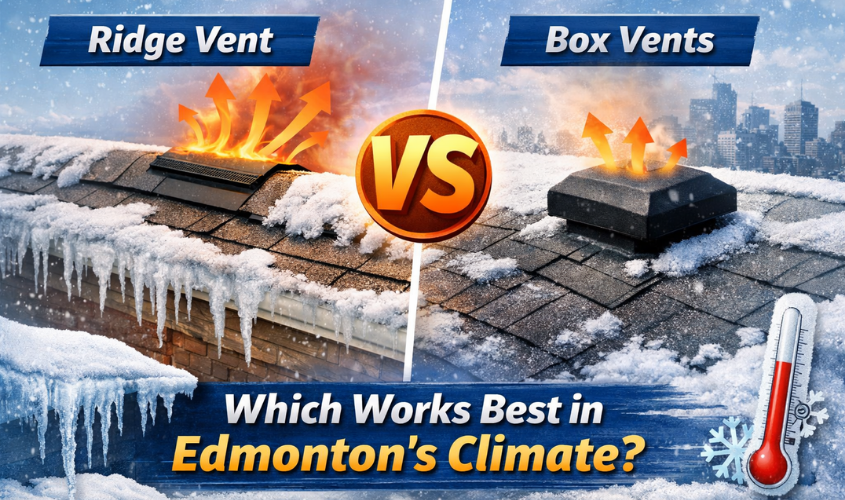
Proper attic ventilation is not optional in Alberta — it directly impacts roof lifespan, shingle performance, insulation efficiency, and winter ice dam formation.
Homeowners often choose between ridge vents and box vents (also called turtle vents), but the real question isn’t which one looks better, it’s which system creates balanced airflow in Edmonton’s freeze-thaw climate.
This guide explains how attic ventilation works, how each system performs, and which option makes sense for your roof structure.
How Roof Ventilation Actually Works
Attic ventilation relies on a principle called the stack effect.
Warm air rises. In winter, heated indoor air naturally moves upward into the attic. If that air becomes trapped, it creates:
- condensation buildup
- insulation moisture
- mold growth
- ice dams along eaves
- premature shingle deterioration
A properly ventilated roof uses:
Intake vents (soffits) → pull cool air in
Exhaust vents (ridge or box vents) → release warm air out
This continuous airflow prevents moisture accumulation and regulates attic temperature.
Without balanced intake and exhaust, ventilation systems fail, regardless of vent type.
Proper ventilation is calculated using net free vent area (NFVA), which ensures enough intake and exhaust openings exist to maintain healthy attic air exchange. Proper attic ventilation also depends on limiting attic air leakage through ceiling penetrations and maintaining an intact vapor barrier.
Air leakage commonly occurs through attic bypasses such as recessed lighting fixtures and attic hatch openings, allowing warm indoor air to enter the attic even when insulation levels appear adequate. Common attic air leaks occur at wiring penetrations, plumbing stacks, wall top plates, and attic hatch covers where warm indoor air can escape into the attic space.
Residential roofing contractors calculate ventilation ratios using the 1:300 or 1:150 guideline to ensure attic airflow meets building performance standards.
Do Ridge Vents Make a House Colder in Winter?
A ridge vent does not make a home colder. Insulation controls indoor temperature, while ventilation controls moisture and attic air temperature. Proper ventilation actually improves heating efficiency by preventing warm attic air from melting roof snow and forming ice dams, which can lead to heat loss and water damage.
What Is a Ridge Vent?
A ridge vent runs along the entire peak of the roof. It creates continuous exhaust across the highest point of the attic.
Can Rain Enter Through a Ridge Vent?
No — modern ridge vents are manufactured with internal baffles and weather filters that block wind-driven rain and snow. Most attic leaks blamed on ridge vents are caused by incorrect shingle installation, missing underlayment, or damaged flashing rather than the vent itself.
Instead of relying on isolated openings, ridge vents allow hot air to escape uniformly along the ridge line.
Advantages of Ridge Vents
- Continuous airflow across entire attic
- Fewer roof penetrations
- Lower leak risk
- Cleaner roof appearance
- More uniform moisture removal
When Ridge Vents Perform Best
- Straight ridge lines
- Proper soffit intake installed
- Standard residential gable roofs
- Homes prone to ice dam formation
Potential Limitations
- Requires adequate intake ventilation
- Not ideal for highly segmented rooflines
- Snow accumulation can temporarily reduce exhaust efficiency
What Are Box (Turtle) Vents?
Box vents are square static vents installed near the roof peak. Multiple units are spaced across the roof surface to exhaust warm air.
Unlike ridge vents, airflow is localized rather than continuous.
Advantages of Box Vents
- Lower installation cost
- Suitable for complex roof shapes
- Easy retrofit without ridge modification
Limitations
- Airflow only at vent locations
- Requires multiple roof penetrations
- Less uniform ventilation
- Higher long-term leak potential if flashing fails
What Are Roof Box Vents?
Box vents (also called static roof vents) are passive exhaust openings installed near the upper portion of the roof. They allow hot attic air to escape through natural convection but only ventilate the area directly around each unit, which can create uneven airflow compared to continuous ridge ventilation.
Ridge Vent vs Box Vent: Performance Comparison
| Feature | Ridge Vent | Box Vent |
| Airflow Distribution | Continuous across ridge | Isolated exhaust points |
| Moisture Removal | More uniform | Limited to vent zones |
| Leak Risk | Lower (single ridge cut) | Higher (multiple penetrations) |
| Winter Ice Dam Prevention | More effective | Moderate |
| Best for Complex Roofs | Less ideal | Better fit |
| Aesthetic Impact | Nearly invisible | Visible protrusions |
In cold climates like Edmonton, consistent moisture removal is critical. Uneven airflow can leave pockets of trapped condensation in attic corners.
Are Ridge Vents Better Than Roof Vents?
In most residential applications, ridge vents provide more consistent ventilation because they exhaust air along the entire peak rather than at isolated points. However, on roofs with multiple ridges or complex geometry, properly spaced box vents may be the more practical solution.
Cold Climate Considerations: Why Vent Choice Matters in Edmonton
Edmonton experiences long winters with repeated freeze-thaw cycles. This creates unique ventilation challenges:
Ice Dams
When attic air is too warm, snow melts on the roof surface and refreezes at the eaves. Ridge vents paired with soffits help equalize attic temperature and reduce this risk.
Condensation
Moisture from bathrooms, kitchens, and daily living rises into attic spaces. Without proper exhaust, water droplets form on roof decking.
Insulation Saturation
Wet insulation loses R-value quickly, increasing heating costs.
For most standard homes in Edmonton, ridge ventilation paired with proper intake provides more balanced performance.
Why Poor Attic Ventilation Causes Ice Dams
Ice dams form when warm attic air heats the roof surface unevenly. Snow melts near the upper roof and refreezes at the colder eaves. As melting continues, trapped water backs up under shingles and enters the roof deck.
When warm moist air reaches the dew point inside the attic, condensation forms along the condensation plane on the underside of the roof decking, especially when relative humidity remains elevated during winter.
This process typically occurs when:
- The attic air temperature is significantly warmer than the outside air
- The insulation is uneven or compressed
- Airflow cannot remove rising heat
- Soffit intake vents are blocked
Balanced ventilation keeps the roof surface temperature consistent, preventing melt-and-refreeze cycles that damage shingles and decking.
Ice dams develop when the roof surface temperature rises above freezing while the eaves remain below freezing due to heat loss and thermal bridging through the ceiling structure.
Ridge Vent on Hip Roofs
Hip roofs have shorter ridge lines, which limit the length available for continuous exhaust ventilation. In these cases, contractors often increase soffit intake or supplement with additional exhaust vents to maintain balanced airflow throughout the attic.
Can You Mix Ridge Vents and Box Vents?
In most cases, mixing vent types disrupts airflow.
Ventilation works by pressure difference. If multiple exhaust systems compete, airflow may short-circuit — pulling air from the nearest vent instead of from soffits.
This results in stagnant attic zones.
Professional assessment is recommended before modifying existing systems.
How to Tell If Your Attic Ventilation Is Failing
Homeowners can often identify ventilation problems without entering the attic fully. Poor airflow typically shows consistent patterns both on the roof and inside the home.
Visual Roof Signs
- uneven snow melt patterns
- ice buildup along eaves
- shingles aging faster near the roof peak
Interior Attic Signs
- frost forming on nail heads
- damp or compressed insulation
- mold or musty odors
- dark staining on the roof decking
Indoor Living Space Signs
- rooms harder to heat in winter
- excessive indoor humidity
- bathroom fans releasing moisture into the attic space
If multiple symptoms appear, attic air exchange is likely insufficient and moisture is accumulating within the roofing system.
How Serious Is the Ventilation Problem?
| Observation | Severity | Recommended Action |
| Light frost on nails | Minor | Monitor conditions |
| Ice forming at eaves | Moderate | Schedule inspection |
| Wet insulation | Major | Ventilation correction needed |
| Mold or dripping water | Critical | Immediate repair required |
Why Mixing Vent Types Causes Problems
Ventilation relies on pressure difference. When multiple exhaust vent styles exist, air follows the path of least resistance and may pull air from another roof vent instead of from soffits. This short-circuits airflow and leaves parts of the attic unventilated.
Common Ridge Vent Problems
Most ridge vent issues result from installation or airflow imbalance rather than the vent design:
- blocked soffit intake vents
- attic insulation covering baffles
- Incorrect ridge opening width
- damaged ridge cap shingles
These conditions prevent proper air movement and lead to moisture buildup. Prolonged moisture exposure can lead to plywood delamination, fastener corrosion, and shingle adhesive failure, eventually shortening the service life of the roofing system.
Persistent moisture also increases wood moisture content, allowing mold spores and rot fungi to develop within the roof structure.
Which Vent System Is Right for Your Home?
Choose Ridge Vent If:
- Your roof has a long, straight ridge
- You want maximum moisture control
- You’re installing new shingles
- You want fewer penetrations
Ridge Vent vs Box Vent Cost Comparison
| System | Typical Cost | Long-Term Consideration |
| Box vents | Lower upfront | More roof penetrations increase leak risk |
| Ridge vent | Higher installation | Better airflow and fewer future repairs |
While ridge vents cost more initially, they often reduce long-term maintenance costs.
Choose Box Vent If:
- Your roof has multiple peaks and valleys
- Retrofitting without ridge modification
- Budget is the primary concern
Long-Term Cost Considerations
Ventilation choice affects more than installation price. Poor airflow increases long-term roofing expenses through:
- premature shingle failure
- Repeated leak repairs
- insulation replacement
- higher heating costs
- roof deck deterioration
Continuous ventilation systems typically reduce maintenance frequency over the lifespan of the roof.
The Most Important Factor: Balanced Intake
Neither system works effectively without soffit intake ventilation.
Many ventilation failures occur because:
- Soffits are blocked by insulation
- The intake area is insufficient
- Attic baffles are missing
Blown-in insulation and batt insulation must be held back with ventilation baffles to keep soffit intake pathways open. A balanced intake and exhaust ratio is more important than vent style alone.
Types of Intake Vents
Building guidelines generally recommend 1 square foot of ventilation area for every 300 square feet of attic floor space to maintain proper air exchange. Exhaust vents cannot function without sufficient intake airflow. Common intake vent designs include:
- Perforated soffit panels — continuous airflow along eaves
- Circular soffit plugs — individual intake openings
- Fascia intake vents — used when soffits are limited
- Drip-edge intake vents — retrofit option for older homes
A correct intake area is required to meet ventilation ratio guidelines (typically 1:300 attic floor area).
Types of Ridge Vents
There are several ridge vent designs:
- Shingle-over ridge vents (most common residential)
- Aluminum ridge vents (high durability)
- External baffle ridge vents (improved airflow performance)
Each type performs the same function but varies in airflow efficiency and weather resistance.
Long-Term Roof Protection and Ventilation
Excess attic moisture accelerates asphalt shingle aging, weakens roof underlayment, and deteriorates roof decking over time.
Proper ventilation:
- Extends shingle lifespan
- Reduces mold risk
- Prevents wood deck rot
- Improves HVAC efficiency
- Protects insulation performance
Incorrect ventilation can shorten roof life by years, especially in cold regions.
Professional Roof Ventilation Assessment in Edmonton
Roofing contractors calculate ventilation needs based on attic square footage and the required ventilation ratio to meet performance guidelines.
Choosing the right vent type requires evaluating:
- Roof geometry
- Attic square footage
- Insulation depth
- Existing intake capacity
- Snow load exposure
A professional roofing contractor can calculate the required ventilation ratio and recommend the most efficient system.
When Ventilation Requires Professional Correction
Professional inspection is recommended if you observe:
- recurring ice dams each winter
- visible attic mold
- insulation consistently damp
- sustained attic humidity above 50%
- frost thicker than a few millimeters on the decking
At this stage, ventilation adjustments alone may not be enough — airflow pathways and insulation air sealing may also need correction.
Frequently Asked Questions
Do ridge vents reduce attic temperature in summer?
Yes. Continuous ridge ventilation allows trapped attic heat to escape evenly across the roof peak, lowering attic temperature and reducing shingle overheating during summer months.
Are box vents outdated?
They remain effective when correctly spaced and paired with adequate intake ventilation. Problems occur when airflow becomes unbalanced, leading to moisture pockets.
Can poor ventilation void roofing warranties?
In some cases, yes. Manufacturers require proper airflow for warranty compliance.
Why do ice dams form even with vents?
Ice dams often result from poor insulation or blocked soffits, not vent type alone.
How many box vents does a roof need?
It depends on attic size and ventilation ratio requirements.
Box Vents vs Turbine Vents
Turbine vents use wind to actively pull air from the attic, while box vents rely on passive heat rise. Turbines can move more air during windy conditions but contain moving parts that may require maintenance. Box vents are simpler but ventilate smaller areas.
Powered attic fans are another exhaust option but can depressurize the attic and pull conditioned air from the home if intake ventilation is insufficient.
Why Do Some People Prefer Ridge Vents Over Box Vents?
Because ridge vents provide continuous airflow, reduce hot spots in the attic, and minimize roof penetrations, lowering long-term leak risk.
Do ridge vents leak in heavy snow?
Properly installed ridge vents include baffles that block wind-driven snow. Most leaks occur from flashing installation errors rather than the vent itself.
Can insulation block attic ventilation?
Yes. Insulation covering soffit openings prevents intake airflow and causes moisture buildup.
Will improving ventilation lower heating bills?
Indirectly. Proper airflow keeps insulation dry, allowing it to maintain its rated R-value.
Quick Decision Guide
- Long straight ridge with soffits → Ridge vent recommended
- Complex or segmented roof → Box vents appropriate
- History of ice dams → Continuous ridge ventilation preferred
- Budget retrofit project → Box vents practical solution
Final Recommendation
In most Edmonton residential applications, ridge vents paired with soffit intake provide more consistent airflow and lower long-term risk.
However, complex roof structures may benefit from strategically placed box vents.
The correct system depends on engineering balance — not just vent style.
Many ventilation problems remain hidden for years before visible leaks appear, which is why inspection is recommended even when the roof surface looks intact.
Professional Roof Ventilation Inspection — J & D Independent Roofing
If your home shows signs of moisture buildup, uneven snow melt, or repeated ice damming, a ventilation imbalance is likely already affecting your roofing system.
J & D Independent Roofing provides detailed roof ventilation assessments that identify airflow restrictions, intake deficiencies, and moisture risk areas before structural damage occurs. The inspection evaluates attic airflow pathways, insulation condition, and exhaust performance to determine whether repair, adjustment, or full ventilation redesign is required.
Early correction prevents deck rot, mold development, and premature roof replacement.
Contact J & D Independent Roofing to schedule a roof ventilation evaluation and ensure your roofing system performs correctly through seasonal temperature extremes.